
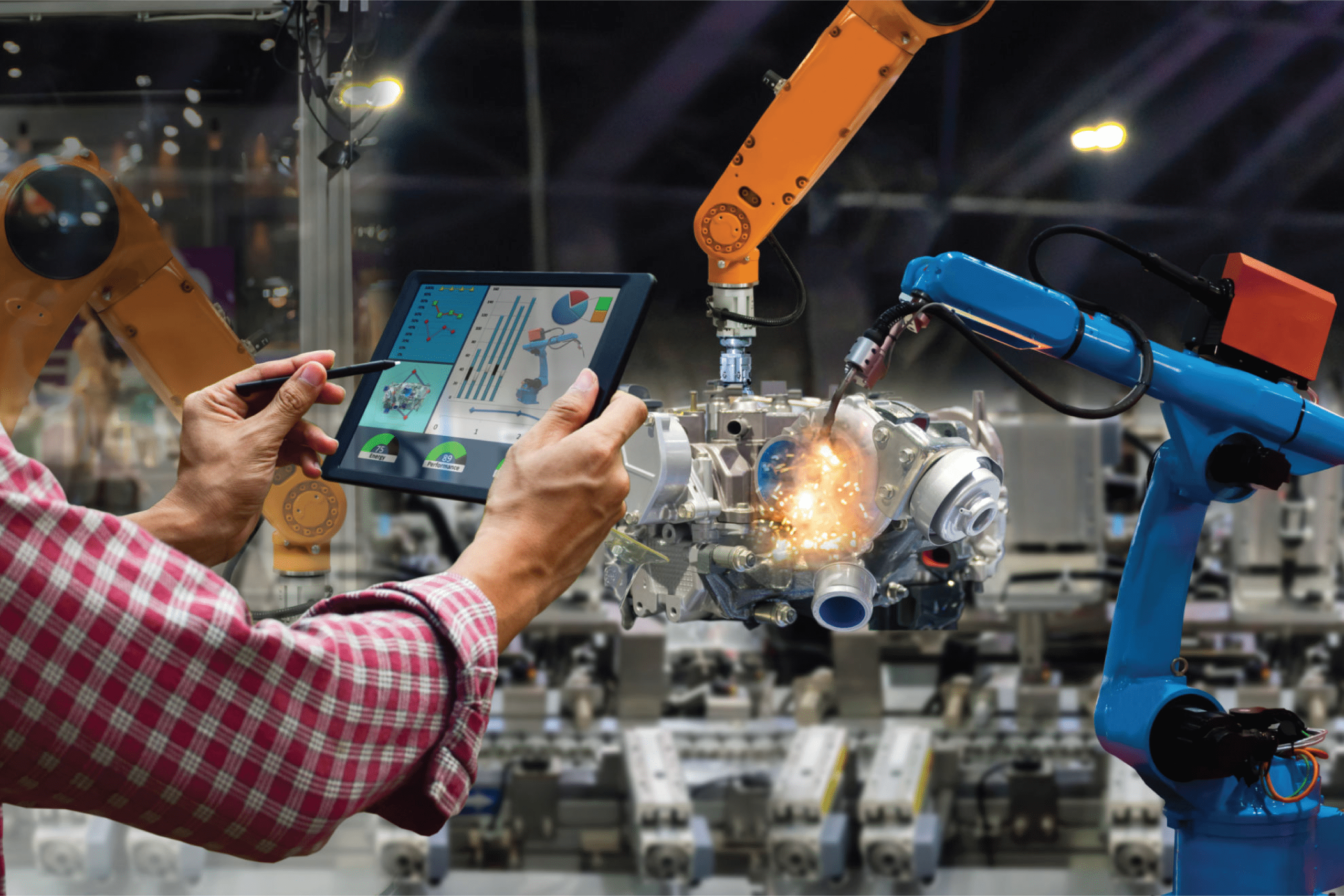
Industrial automation is ubiquitous in today’s factories and shops, and it’s impossible to picture a production line without it. Control systems and equipment, such as computer software and robots, are used in industrial automation to accomplish tasks that were formerly performed manually. These systems automate the operation of industrial equipment, minimizing the amount of operator interaction and oversight required. Due to the digitization of industry, notably with the Industrial Internet of Things (IIoT), industrial automation technologies have improved dramatically in recent years, providing more and more options for businesses to benefit from automation solutions. Industrial Automation is the process of using digital logical programming to operate machines and other industrial equipment, decreasing human interaction in decision-making and manual command processes, and using mechanized equipment to do so.
Mainly Industrial automation is the autonomous control of machines and processes in many sectors using technology such as robotics and computer software. Automation is used in industries to increase production while lowering costs associated with personnel, their benefits, and other related expenses. It also improves precision and flexibility. With the Industrial Revolution came mechanization, which brought cheaper and more plentiful goods. Generally, the mechanical processes in industries were faster and produced greater quantities of goods but still required skilled workers. Not only did machines require operators but when errors occurred, they would waste materials, cause production issues and even damage equipment. Automation refers to a group of technologies that lessen the need for humans to intervene in operations. Predetermining decision criteria, sub-process linkages, and related actions — and encoding those per-determinations in computers — reduces human intervention.
An industrial production process is made up of a set of machinery that process a mixture of raw materials and change them into the finished product. The term “machine” here refers to electro mechanical equipment such as motors, drills, and conveyor belts, as well as chemical machines such as ovens, dryers, and chemical combustion systems. Industrial Automation has taken over the manufacturing process in today’s world, and it’s difficult to picture a production line without it. Several factors contribute to the adoption of automation systems in industrial production, including the need for high-quality products, high expectations for product reliability, and large-volume manufacturing, among others.
Industrial Automation are usually categorized into four types.
• Fixed Automation
• Programmable Automation
• Flexible Automation
• Integrated Automation
Advantages
- Human operators can simply be replaced for tasks that require laborious manual labor
- Human operators can avoid working in potentially hazardous manufacturing situations such as those with high temperatures, pollutants, intoxicating components, or radioactive materials
- Tasks that would be challenging for a regular human operator can be completed quickly
- Lifting huge and large loads, working with incredibly small objects, and so on are examples of these duties
- Production is always faster, and product costs are much lower (when compared to the same product that is produced with manual operation)
- To ensure consistency and uniformity, certain quality control tests can be introduced into the manufacturing process
- The industry’s economy can be greatly enhanced, which has a direct impact on people’s living standards
Disadvantages
- With today’s technology, it is impossible to automate all of the desired tasks
- Products of unusual shapes and sizes, for example, are best assembled by hand
- Automation is feasible for some processes, such as high-volume production, repeatable and uniform products
- The cost of developing an automated system is really expensive at first
- Maintenance and service always necessitate the presence of skilled staff