

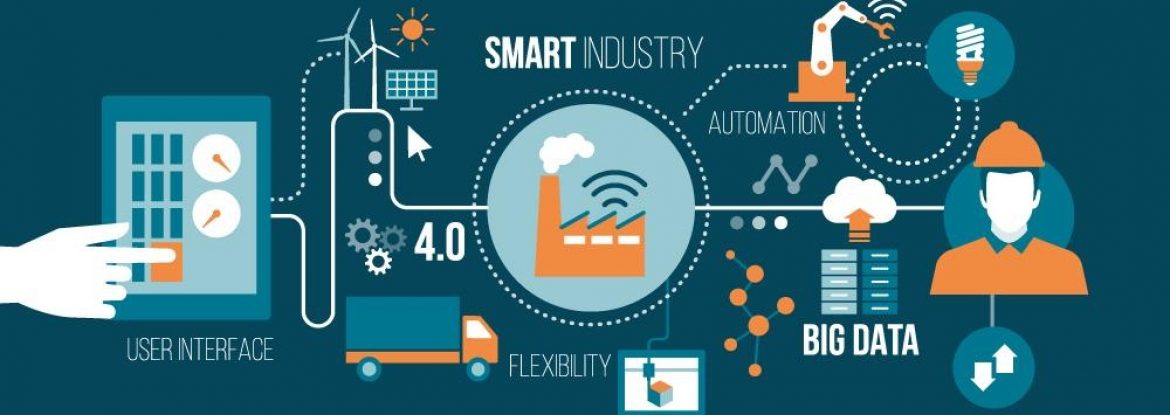
Smart factories that use high-tech IoT devices have increased production and better quality. Using AI-powered visual insights to replace manual inspection business models decreases production mistakes and saves money and time. Quality control staff may set up a smartphone connected to the cloud with minimum expense to monitor production operations from nearly anywhere. Manufacturers can spot mistakes sooner rather than later, when repair work is more expensive, by using machine learning algorithms.
The principles and technologies of Industry 4.0 may be used in a variety of industries, including discrete and process manufacturing, as well as oil and gas, mining, and other sectors.
Pioneer Technologies for Driving Industry 4.0
Internet of Things (IoT)
Smart factories rely heavily on the Internet of Things (IoT). On the manufacturing floor, sensors with an IP address are installed, allowing the machines to communicate with other web-enabled equipment. Large volumes of important data can be collected, analyzed, and distributed thanks to this mechanization and connectedness.
Cloud Computing
Any Industry 4.0 plan must include cloud computing. Engineering, supply chain, production, sales and distribution, and service must all be connected and integrated for smart manufacturing to be fully realized. This is made feasible through the cloud. Furthermore, cloud computing allows for more efficient and cost-effective processing of the generally vast amounts of data that must be stored and evaluated.
AI and Machine Learning
Manufacturing businesses may use AI and machine learning to fully use the abundance of data created not just on the factory floor, but also throughout their business divisions and from partners and third-party sources. AI and machine learning may provide insights into operations and business processes, allowing for visibility, predictability, and automation. For example, industrial machinery are prone to malfunctioning throughout the manufacturing process. Businesses may use data generated from these assets to undertake predictive maintenance using machine learning algorithms, resulting in increased uptime and efficiency.
Edge Computing
Because of the needs of real-time manufacturing, some data analysis must be performed at the "edge"—that is, where the data is generated. This reduces the time between when data is generated and when a response is required. For example, detecting a safety or quality issue with equipment may necessitate near-real-time response. The time it takes to transport data to the business cloud and then back to the manufacturing floor might be excessive, and it is dependent on network stability. Edge computing also keeps data close to its source, lowering security threats.
Cybersecurity
Cybersecurity and cyber-physical systems have not always been a priority for manufacturing businesses. However, the same factory or field (OT) connection that allows for more efficient production operations also opens up new entry points for harmful assaults and viruses. It is critical to adopt a cybersecurity solution that includes both IT and OT equipment while conducting a digital transformation to Industry 4.0.
Digital Twin
Manufacturers may now construct digital twins, which are virtual clones of processes, manufacturing lines, factories, and supply networks, thanks to Industry 4.0's digital revolution. Data from IoT sensors, gadgets, PLCs, and other internet-connected things is used to construct a digital twin. Digital twins can help manufacturers enhance efficiency, optimize operations, and create innovative products. Manufacturers can evaluate modifications to a manufacturing process by simulating it, for example, to identify methods to reduce downtime or increase capacity.