

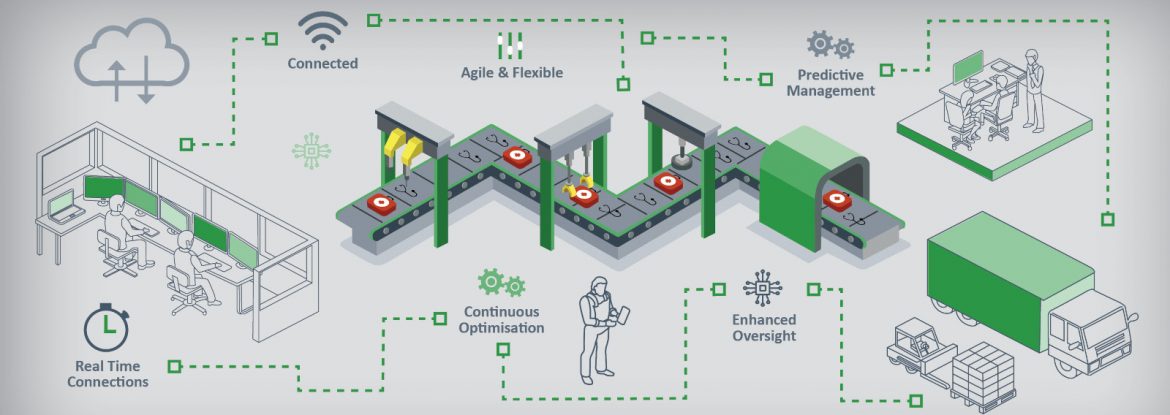
Before we get into the specifics of the smart factory, a few words on its underlying idea, the Industrial Internet of Things, are necessary. Though the concept has been around for a while, not everyone is aware of what it entails and what its many elements are. The IIoT is similar to the conventional Internet of Things in that it promises to strengthen our everyday lives by networking items and allowing them to communicate and collaborate to provide us better and faster answers to our daily difficulties (remember smart coffee makers?). So, to talk about a true IIoT deployment, we need to talk about not only machine-to-machine communication, but also bridging the gap between physical and digital assets inside a plant and minimizing man-machine interaction through smart automation and machine learning.
If it weren't for the benefits that the adoption of smart manufacturing processes can offer to any organization, there would be no buzz or double-digit growth forecasts surrounding the notion of Factory 4.0.
If it weren't for the benefits that the adoption of smart manufacturing processes can offer to any organization, there would be no buzz or double-digit growth forecasts surrounding the notion of Factory 4.0. Using automation and intelligence to create a dynamic production environment enhances dependability, effectiveness, and safety while lowering operating and downtime costs. Let's take a deeper look at how this is implemented inside the smart factory idea.
- Production Process Monitoring
Every manufacturing process, whether completely human or fully automated, must be monitored in order to be regulated, effective, and safe. As a result, IoT initiatives in this industry sector must focus on tracking operations at all levels and acquiring useful data from machines or assets that would otherwise be separate pieces of equipment incapable of coordinating and controlling their own workflow.
However, the increased oversight and monitoring capabilities that the communication and interaction between the production tools offer to the process are not the only benefits. Improvements may be made in real-time using smart factory production techniques, swiftly leading to production cycle optimization. Furthermore, the more automated and regulated a process is, the less susceptible it is to human mistakes, which boosts productivity by lowering downtime and maintenance costs while also improving end-product quality.